
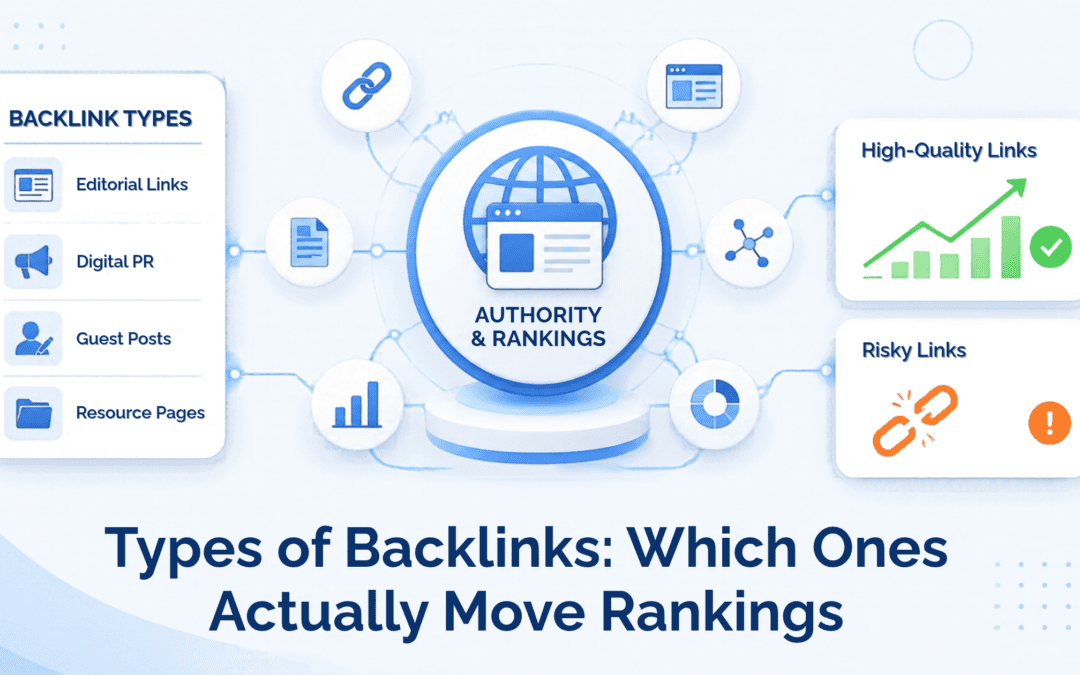
Ask ten SEOs to list the types of backlinks and you’ll get ten different lists. Some stop at four. Others run past twenty, with badge links, scholarship links and webinar links all getting their own heading. Very few of them say which links are worth the trouble, and that’s the part you need when you’re deciding where a link building budget should go.
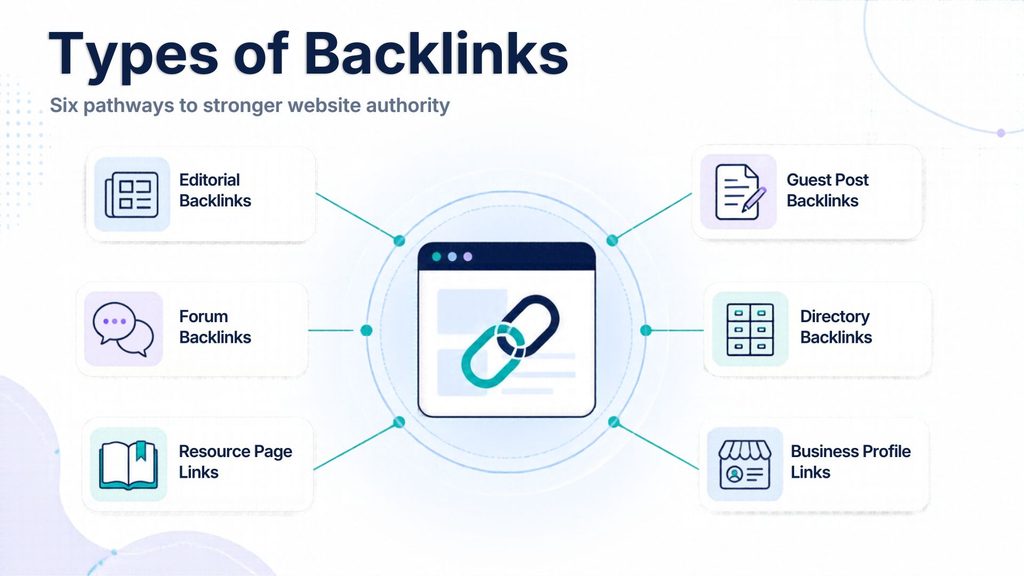
Links that someone gave you on their own, from a site in your field, are the ones that shift rankings. Press coverage, a spot on a well-kept resource page and the odd guest article on a respected blog can all get you those. Directory listings, social profiles and forum backlinks are fine to have but do very little for rankings. Paid links that pass ranking credit are where people tend to get burned, along with private blog networks and big link-swap arrangements.
New to backlinks? Our guide on what backlinks are and why they still matter covers the basics, so we’ll skip them here.
How backlink types are classified
Backlinks get labelled in at least three unrelated ways, and most articles on backlink types mix them up. There’s the HTML attribute (follow, nofollow, sponsored, ugc). There’s how the link came about, whether it was earned, built through outreach or bought. And there’s position and wording, meaning body copy versus footer and branded anchor versus keyword anchor.
One link can carry all of those labels at once. When a reporter quotes your survey, you get an editorial link that’s followed, sits in the body and is probably anchored on your company name. When you comment on a WordPress blog, WordPress tags your link nofollow and ugc automatically, so you end up with a self-made comment link that passes nothing.
The attribute is the one label you never get to choose, since the site linking to you sets it.
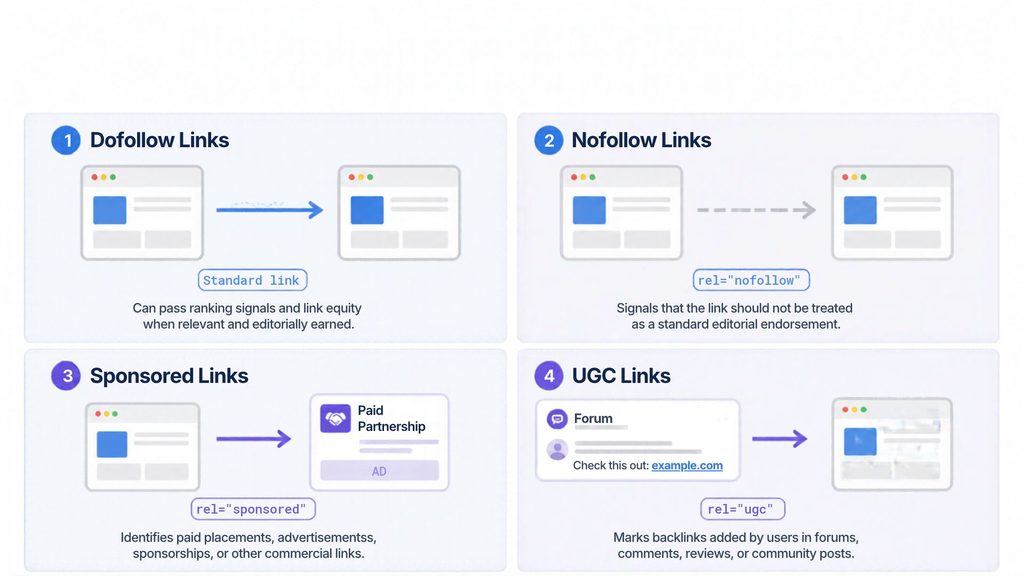
Dofollow, nofollow, sponsored and UGC backlinks
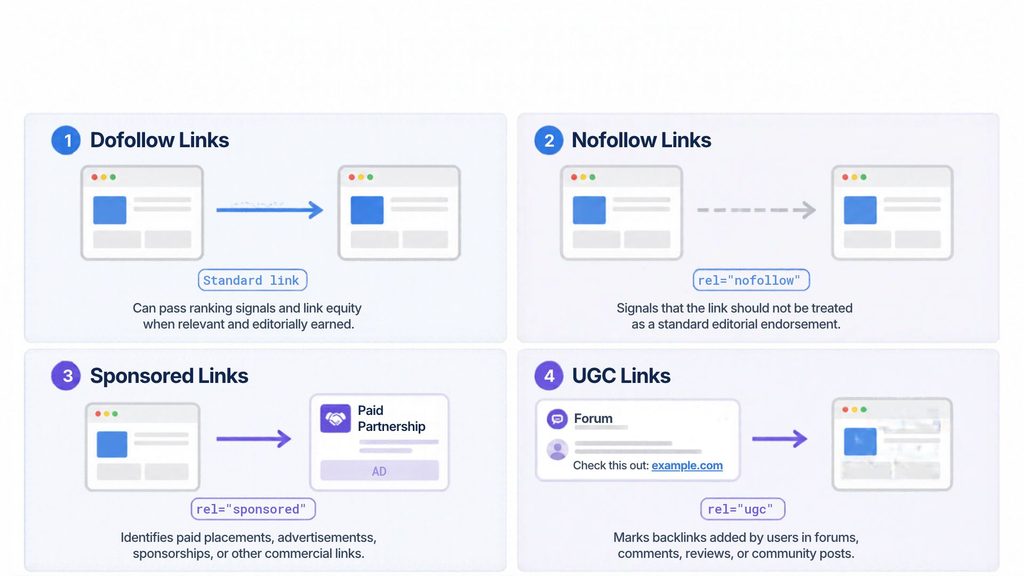
Google brought in nofollow back in 2005, mainly to choke off comment spam. In September 2019 (the 10th, if you’re keeping track) it added sponsored for paid placements and ugc for user-generated content, and said all three would be treated as hints from then on instead of commands.
A link with none of these values is a normal followed link, and it’s the only kind meant to pass link equity to your page. Sponsored should go on anything paid for, affiliate links included. Ugc belongs on comments and forum posts, and nofollow covers everything else a site doesn’t want to vouch for. Sites can combine them too, so a paid link inside a forum post might carry
The “hint” part means Google may still use one of these links for crawling or ranking. How often it does that, nobody outside Google knows. We’d plan as if these links pass nothing and treat anything more as a bonus.
Nofollow links can still pay off in other ways. Wikipedia nofollows every external link, yet a citation there can be worth having, because writers dig through Wikipedia’s references when they research a topic and some of them will cite your page in their own work with a normal link. Big publications that nofollow their outbound links work in a similar way. Count these for the traffic and exposure, and leave them out of any report on ranking wins.
The types of backlinks that actually move rankings
Five link types belong here. What they share is simple enough: a person running a site in your field decided to link to you.
Editorial backlinks
This is the one everyone is chasing. A writer is putting together an article, your page supports a point they’re making, and they link to it. You didn’t ask and you didn’t pay. When people talk about authority backlinks that genuinely shift rankings, they usually mean these.
The content that earns editorial links tends to save other writers work. Original numbers are the most reliable example. If your SaaS product can publish an annual benchmark from anonymised usage data, every blogger writing about that metric needs a figure, and yours is the one they can cite. Free tools and templates earn links for a related reason (linking to a working calculator is easier than explaining the maths), and so does a plain explanation of something your industry usually explains badly.
The frustrating bit is that someone else always makes the final call. All you can do is build the page and get it in front of the people who write about your topic.
Digital PR backlinks
Digital PR is what happens when you stop waiting for editorial links and go after them on purpose. You turn a survey, a data set or a sharp expert comment into a story, then pitch it to reporters who cover your industry. Our walkthrough of digital PR for SEO goes into how those pitches are put together.
When a campaign lands, the links come from news sites and trade magazines, places that would never run a guest post from you. They’re usually high authority backlinks by any metric you care to use. Pay attention to where the coverage appears, though. A line in a national paper’s business pages is nice. A feature in the trade magazine your buyers actually subscribe to is often worth more, for relevance and for the visitors it sends.
Resource page backlinks
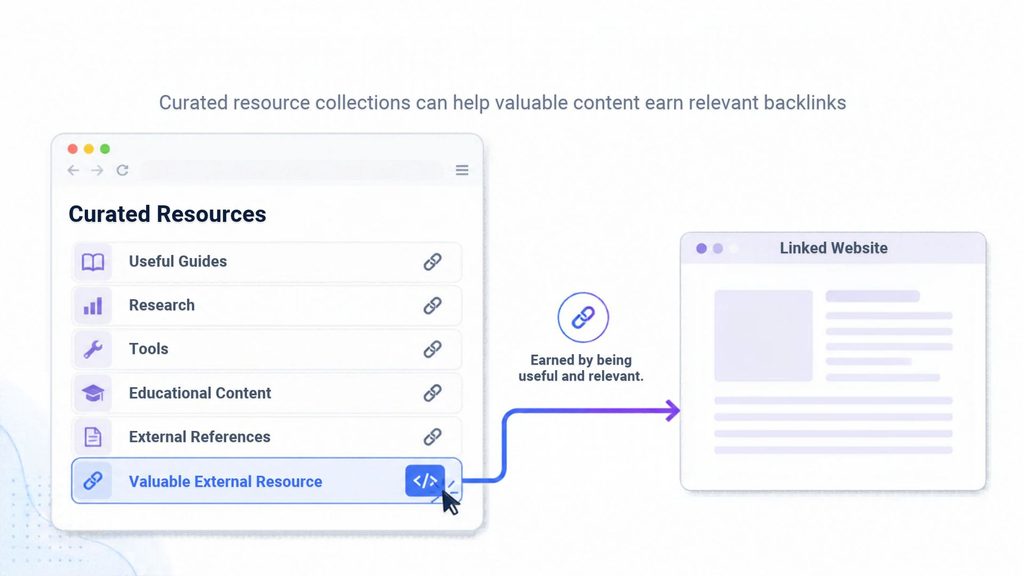
Plenty of organisations keep curated lists for their readers. University libraries list research tools, trade associations list approved suppliers, and bloggers keep pages of free templates they like. If your resource genuinely belongs on one of those lists, a short, specific email to whoever maintains it is usually all it takes.
These are relevant backlinks by design, since the page exists to send readers to good material on one topic. Some lists are much better company than others. Fifteen hand-picked links with a line of description each is a far better neighbourhood than a page of three hundred URLs and no context, and resource page link building pays off most when you’re fussy about which pages you approach.
Guest post backlinks
Guest posting is fine when the article would deserve a place on that site even without your link in it. Write something useful for a respected blog in your niche, link to your own page where it helps the reader, and you’re doing ordinary contributed content.
What gets people into trouble is volume combined with keyword anchors. Google’s spam policies specifically list optimized anchor text in guest posts distributed on other sites as link spam. Fifty thin articles on blogs that publish anyone, each pointing “best CRM software” at a product page, is pretty much the textbook case.
Bio links are weaker than links in the article body, though they look less manipulative too. If guest posts are a regular part of your plan, set up a proper blogger outreach and guest posting process for checking sites before you pitch, because the host site’s standards decide most of what the link is worth.
Brand mention backlinks
Companies get mentioned without a link all the time, in podcast show notes, conference write-ups, comparison posts and roundups. Those are about the easiest editorial links you’ll ever win, because the writer has already decided to name you and turning that mention into a link is a thirty-second edit on their side. Links that broke after a migration or a deleted page go in the same bucket, and link reclamation covers how to find both and ask without being a nuisance.
Backlink types with limited SEO value
None of the following will hurt you if you keep them sensible. Judge them by the traffic and visibility they bring, because they won’t do much for competitive rankings.
Directory and business listing backlinks
Listings help people confirm you exist, and for software companies, review sites like G2 and Capterra are where buyers often compare vendors. A handful of relevant ones makes sense. Google’s spam policies call out low-quality directory and bookmark site links as link spam, and our rule of thumb is that a directory with no audience of its own is only there to sell links.
Forum and blog comment backlinks
Forum backlinks and blog comment links nearly always carry ugc or nofollow, and decent moderators delete self-promotion fast. Where they’re genuinely useful is traffic. A thorough answer in a niche forum or an active subreddit can keep sending interested people your way for a long time, as long as your link actually answers the question.
Social profile backlinks
LinkedIn, X, YouTube and app marketplace profiles normally link out with nofollow. They tie your brand together across platforms, which helps with branded searches, and that’s about the extent of it. For non-branded keywords they won’t move anything.
Press release backlinks
Put a release on a wire service and the identical text, links and all, gets republished across dozens of syndication sites. Most of those links are nofollowed, and Google lists optimized anchors in distributed press releases as link spam. Any link worth having from a release comes afterwards, when a journalist decides the news deserves their own story.
Toxic backlink types that can hurt your rankings
Google defines link spam as links made mainly to manipulate rankings. The simplest test we know is to ask whether a link would exist if search engines didn’t. For everything below, usually not.
- Paid links that pass ranking credit. Paying is fine if the link is marked sponsored or nofollow. Plenty of people selling “guest posts” or “sponsored articles” leave the links followed anyway, and the buyer is the one carrying the risk.
- Private blog networks, which are sites owned by one party and kept alive mainly to link to each other or to paying clients. Their third-party metrics often look healthy, while real readers are close to none.
- Bulk link exchanges. Two related sites linking to each other now and then is normal. A standing swap arrangement is a scheme, and our explainer on link exchanges and paid links covers where the line usually falls.
- Keyword-rich links hidden in widgets or themes that end up on hundreds of unrelated sites.
- Software that churns out profile, comment or bookmark links in bulk.
Most of this gets neutralized by Google’s link spam systems, so the money spent on it just disappears. When the pattern is big and obviously deliberate, a manual action is possible, and getting out of one means cleaning up or disavowing links and filing a reconsideration request.
How to evaluate backlink quality
Two links of the same type can be miles apart in value. Picture two guest posts. One sits on an industry blog your buyers read every week, and the other is on a site that’ll publish anything if you pay the fee. Your backlink report files both under “guest post links”, but you’d be lucky if the second one did anything at all.
Most people start with Domain Rating or Domain Authority, which nearly every backlink checker tool shows. That’s a fair first filter. Those scores come from the tool companies, not from Google, and plenty of sites with a nice-looking number have hardly any readers. Once a link gets past that check, these are the four things we look at.
Relevant backlinks vs high authority backlinks
Relevant backlinks tell Google what your site is about as well as how much it’s trusted. Check the site’s overall subject and then the subject of the actual page. For a CRM company, a link from a post about managing a sales pipeline on a mid-sized business blog will usually do more than a link from a travel deals page on a much bigger site.
Authority still matters, since a page with strong links of its own has more to pass along, and authority backlinks from respected sites are worth the effort. Ideally you get both. High authority backlinks from pages that have nothing to do with you are the ones that tend to disappoint.
Editorial context around the link
Read the sentence around the link. If it cites your data, recommends your tool or credits your idea, a reader would understand why it’s there. If the paragraph reads just as well with the link removed, it was probably placed rather than earned.
Link placement and anchor text
Body copy beats footers, sidebars and bios. As for anchors, earned links mostly use a brand name, a URL or a plain description, so when lots of links share the same commercial phrase it looks engineered. Our piece on anchor text in SEO covers what a natural mix looks like.
Traffic on the linking page
A page that ranks and gets traffic is a better source than one nobody visits. A site that writes about everything, has no visible audience and sells placements openly isn’t worth much, whatever its domain metrics say.
Types of backlinks compared
| Backlink type | Usual attribute | Ranking impact | Effort to get | Risk |
|---|---|---|---|---|
| Editorial links | Follow | High | High | Low |
| Digital PR coverage | Mostly follow | High | High | Low |
| Resource page links | Follow | Medium to high | Medium | Low |
| Brand mention links | Follow | Medium to high | Low | Low |
| Guest post links | Follow or nofollow | Medium | Medium | Medium at scale with keyword anchors |
| Directory and listing links | Mixed | Low | Low | Low if relevant, high for spam directories |
| Forum and comment links | ugc or nofollow | Low | Low | Low unless spammy |
| Social and profile links | Nofollow | Very low | Low | Low |
| Press release wire links | Mostly nofollow | Very low | Low | Medium with optimized anchors |
| Paid followed links, PBNs, link schemes | Follow | Short-lived at best | Varies | High |
You can use this as a rough audit lens as well. Pull up your backlink profile and see where most of your links sit. Mostly upper rows, with some listings and social links around them, is healthy. A profile sitting mostly in the bottom rows deserves a closer look.
Where to start with link building
Out of all the types of backlinks covered here, the ones worth most of your time come from someone running a relevant site who linked to you because it helped their readers. Editorial links, PR coverage, resource listings, careful guest posts and reclaimed mentions can all get you there. Directories, profiles and forums are fine for visibility. Paid followed links, PBNs and link swaps are a gamble we wouldn’t take.
So where do you start? With your own site, honestly. Go through it and pick out the two or three pages someone might actually want to cite. Maybe that’s a survey you ran last year, a pricing calculator, or the one guide you’re genuinely proud of. Then think about how each one gets found. Survey data is worth pitching to journalists, a calculator fits nicely on resource pages, and a strong guide can be the starting point for a guest article.
FAQ
What are the main types of backlinks?
By attribute there are four: followed, nofollow, sponsored and ugc. By origin, the common ones are editorial links, digital PR links, resource page links, guest post links, reclaimed mentions, directory and profile links, forum and comment links, and paid links.
Do nofollow backlinks help SEO?
Sometimes, indirectly. Google treats nofollow as a hint and may count some, though you can’t tell which. The dependable benefits are referral traffic and exposure that can lead to followed links later.
Are forum backlinks good for SEO?
For rankings, rarely, since forums mark links as ugc or nofollow. For reaching people who are asking about your exact topic, a helpful forum answer can beat a mediocre followed link.
Which type of backlink is the most effective?
An editorial link from a relevant site that people actually read. One of those usually outweighs a large pile of directory, profile or comment links.
Can bad backlinks hurt my site?
Most junk links are simply ignored. The risk comes from patterns that look deliberate, such as paid followed links or large-scale swaps, which can lead to a manual action if Google reviews the site.
How many backlinks do I need to rank?
There’s no fixed number. It depends on the links pointing at the pages already ranking for your keyword, so compare your page against those competitors instead of chasing a target count. A few relevant editorial links can be enough in a low-competition niche.