
Many SaaS businesses are looking to invest in new agencies, llms.txt files and chunked content to get their product in ChatGPT. However, many of these strategies may be ineffective. Answer Engine Optimisation (AEO) is best considered as a type of SEO, although there are some differences in where traffic comes from and how success is measured.
In May 2026, Google published guidance on optimising content for generative AI within its search engine. They state that “optimizing for the search experience, and thus still SEO”.
What is AEO in marketing?
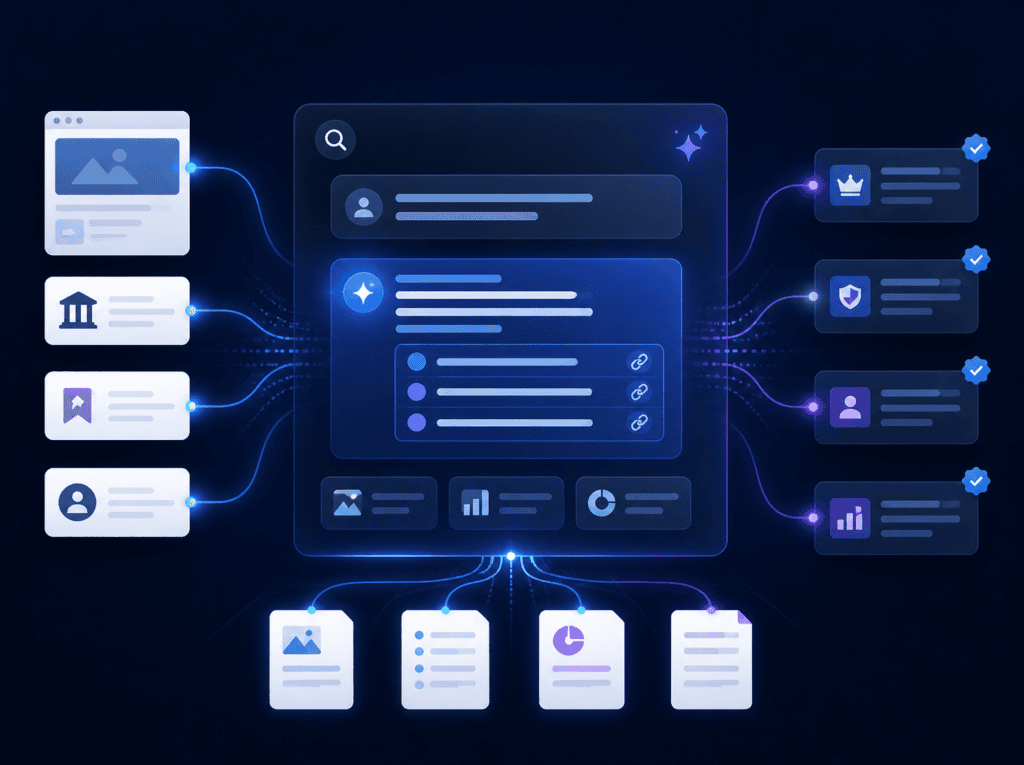
Answer engines provide answers to queries. These include AI Overviews and AI Mode in Google Search, ChatGPT, Perplexity and Copilot. Answer engine optimisation (AEO) aims to get your content cited in answer engines so that when customers ask questions, they may be answered with a mention to your brand.
Although AEO was used before the emergence of large language models (originally to refer to featured snippets, People Also Ask and knowledge panels), it is now largely referring to AI generated content. It is sometimes referred to as GEO. Due to the high overlap in the terms, we consider them to be the same activity. To learn more about getting content cited, see our guide to generative engine optimisation.
What changes in AEO for B2B SaaS?
Customers may now ask AI to compare 3 vendors within their 50 person startup, giving a shortlist of vendors within the answer. If your content is not included in this answer, you may be missing out completely.
Key differences between AEO and SEO
Differences in content sources
Within Google Search, AI Overviews can be created in 2 ways. In retrieval augmented generation (grounding), AI uses content from the search index (with clickable links) to create an answer. In query fan out, multiple related queries are searched. If a user is asking how to improve a weedy garden, the related queries may be ‘herbicides for lawns’, ‘natural ways of weeding’ and ‘prevent weeds’.
If a page is not performing well in search, it is likely to be less likely to be cited in AI Overviews. To be eligible to be cited in AI Overviews, the page must be indexed, show a snippet in Google Search and the site must be included in generative AI features within Search Console.
The query fan out may lead to confusing results. A page ranking in position 6 may be cited in the answer, and a page in position 1 may not. As multiple sub-queries are made, it is possible that a page answers one of them very well and gets cited. (Note: This is our understanding of how citations occur within AI answers. This is not a statement made by Google.) Therefore, it is best to group questions in AEO content. If you are prioritising Google, see our walkthrough on how to rank in AI Overviews.
Differences in scoring
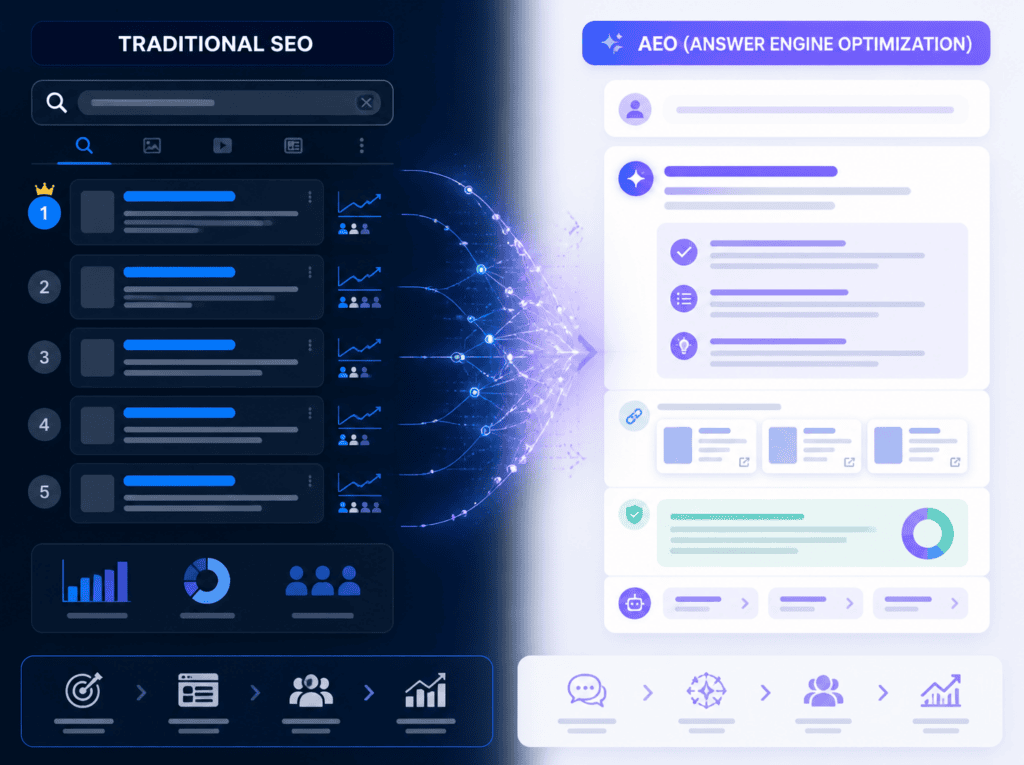
Within traditional SEO we score content based on its ranking and clicks. Within AEO we score content based on if it is cited. Even if content is not clicked, if it is cited in an answer it may be added to a shortlist. It can be difficult to track this in GA4.
Clicks still matter. Google states that results with AI Overviews have more clicks and customers spend longer on the site. Note that this is a statement by Google about its own product. We feel that the main difference is in tracking. If a SaaS business is only tracking traffic from organic sources, they may be underestimating the impact of AEO on their pipeline.
Tactics to not use for AEO in Google

There are a number of common misconceptions to avoid in AEO. For Google Search, you do not need to:
- Have llms.txt files (or other AI specific files/structure). They are not used by Google Search, and therefore have no impact on visibility.
- Chunk content. Google can rank content which covers multiple topics, and there is no ideal length.
- Rewrite content for AI. Google understands synonyms and does not require all versions of long tail phrases.
- Inauthentic mentions. Spam is prevented by the same filters as generative features.
- Special structured data. Structured data is not required to be included in generative AI results. However, Google does recommend including it to ensure pages remain eligible for rich results.
Note: This only applies to Google answer engines (AI Overviews and AI Mode). If you want to appear in answer engines from third parties, and the platform uses llms.txt, it will take little effort to have one on your site. However, it will not have an impact in Google.
Answer engine optimisation for other engines (ChatGPT, Perplexity, Copilot)
ChatGPT
Content can be crawled by ChatGPT in search features (OAI-SearchBot) and model training (GPTBot). The robots.txt settings for these bots are separate. You may choose to allow OAI-SearchBot to crawl your site for search results but block GPTBot from crawling for training. If OAI-SearchBot is blocked, your site will not be included in answers in ChatGPT search results. However, it may be included as navigational links. See our guide to ranking in ChatGPT for more information.
Perplexity
To be visible in Perplexity results, we recommend that you allow PerplexityBot in your robots.txt and within the IP ranges published.
Microsoft Copilot
Microsoft has the most information available for site owners. Within Bing Webmaster Tools, there is a public preview called AI Performance. This allows you to see how content is cited in Copilot and in AI summaries in Bing. It does not include other assistants, like ChatGPT. As content is crawled, indexed and ranked in the same way in Bing search and Copilot, this is a great time to double check that your site is visible. Setting this up can be done quickly, and importing sites from Google Search Console will make it even faster.
6 steps to create an AEO strategy
We apply the following steps in AEO within SEO for SaaS clients. These steps add additional checks and content to the strategy which may be missed within a standard SEO strategy.
1. Ensure content is visible in answer engines
Check robots.txt and beyond. Within Google’s checklist, ensure that content is being crawled by checking in robots.txt and within your CDN/hosting. This can be easily missed. Within CDNs, security features may prevent crawling by bots. This may mean that crawlers are challenged or blocked. If your website is hosted on Cloudflare, see our Cloudflare SEO post to find out which features may be impacting search bots.
Ensure JavaScript content is visible. If JavaScript content is not blocked, Google can still read it. However, Google notes that SEO for JavaScript frameworks can be more complex. A full technical SEO audit should pick up most of these issues.
2. Identify questions customers are asking
As query fan out rewards content which answers multiple sub-questions within a topic, consider what questions a customer may ask while making a decision to purchase within each product category. Consider questions like: How does this category work? How do the vendors compare? What is the cost? Will it integrate with other tools? What issues are people facing after purchasing? Consider which of these questions your site already answers well.
Use a logical structure of pillar pages and sub pages to answer the questions to build topical authority. Try to avoid creating many pages to answer different variations of the same question. Google notes that creating many pages to manipulate rankings and AI results is against their scaled content abuse spam policy. If you have 100 thin pages, it will not make your site appear as an expert.
3. Answer questions directly below headings
Answer the question directly below the heading, and any additional information. This makes content easier to scan on mobile devices and makes it easier for retrieval systems. Google recommends creating content for people, with clear headings to make navigation easy.
If, on a page outlining integrations, the question “Does it sync with HubSpot?” is followed by 3 paragraphs about company values, it is a poor source of information. If however, the first line of content says “Yes, contacts and deal stages sync both ways every 15 minutes”, the question can be cited.
This follows standard SEO best practice. Define any new terms, and ensure factual information (pricing, plan limits) is consistent across pages so that there is never conflicting information.
4. Create unique content
Although many AEO checklists do not include this, Google note that creating unique, interesting and useful content will have the greatest long term impact on appearing in generative AI search. As many sources are cited in answer engines, if your content is similar to 10 other pieces of content, there is little reason for the AI to cite your content.
Rather than generic content (such as ‘7 tips for first time home buyers’), Google suggest creating content from personal experience. In SaaS this could be providing data on how your product is used, honest content on migrations, comparisons of products from real experience and benchmarking results.
Suppose one page lists standard features, and another page provides data on how many hours per week customers are spending using this product (based on anonymised data from users of the product). The second page provides information which is not available elsewhere, so this would be a good page to cite.
5. Get mentions in places customers and answer engines look
Within generative features, Google may cite mentions of products in blogs, videos and forums. If a brand has little off page presence, they may be excluded from shortlists of vendors in AI answers. This cannot be fixed with on page optimisation, nor with fake mentions due to the warning above.
Getting genuine mentions will take time. Publishing useful research, ensuring accurate coverage in review and comparison sites, and having team members answer questions in communities with their own names will all help. Digital PR is the most reliable way to get regular coverage.
6. Measure citations
Within Google Search Console, there is a generative AI performance report. Within Bing, there is an AI Performance report. To measure citations in ChatGPT, Perplexity and Gemini, you will need to use LLM visibility tools. These run a series of prompts regularly to see which brands are being mentioned. Note that no third party tools have access to Google’s internal ranking or AI systems.
Choose between 20-50 prompts which reflect real questions that customers may ask. Run every month, and include a citation share in your report alongside organic traffic and demo requests. We believe changes in citation rates for these prompts will be picked up quicker than changes in traffic volumes.
AEO vs SEO Comparison Table
| Factor | Traditional SEO | Answer Engine Optimisation (AEO) |
|---|---|---|
| Goal | Rank content in organic search results | Get cited/mentioned in AI answers |
| Appear in | Google and Bing search results | AI Overviews, AI Mode, ChatGPT, Perplexity, Copilot. |
| Measure success by | Position, impressions and clicks | Citations, mentions and share of answers |
| Content found by | Crawling, indexing, ranking | Crawling, indexing, ranking and individual crawlers for each engine (OAI-SearchBot, PerplexityBot). |
| Content made visible | Relevance, backlinks, good UX | Relevance, backlinks, direct answers to questions and unique content. |
| Off page signals | Backlinks | Backlinks and mentions in press, reviews and forums. |
| Tools to measure | Search Console and rank tracking | Generative AI report in Search Console, AI Performance in Bing, LLM visibility tools. |
| Common error | Not matching intent with keywords | Paying for techniques that Google says are not important. |
Should AEO be a separate budget to SEO?
In most cases, no. Although it may be useful to separate AEO and SEO in reporting, within team structures, it is much less useful. Both AEO and SEO require the same technical set up, content and signals of authority. Google have also stated that their AI features use their core ranking systems.
However, extra budgets may be required to produce original research and get it covered by PR. By adding a citation report to monthly SEO reviews, the measurement aspect is covered. If an agency is pitching AEO as a standalone service, based on llms.txt and chunked content, ask them how this aligns with what was published by Google in May.
FAQs
Is AEO replacing SEO?
No. AEO relies on SEO. Google’s AI Overviews and AI Mode pull pages from the standard search index, using the core ranking systems. Therefore, a strong SEO strategy will increase your chances of being cited.
What is the difference between AEO and GEO?
Very little. AEO was used previously in featured snippets and voice search. Now, GEO is more commonly used in describing AI generated answers (ChatGPT, Perplexity etc.). Both simply mean that your content is being cited by AI. Google considers both of these to be SEO.
Do I need an llms.txt file for AEO?
No (in Google). Google Search ignores llms.txt files so having one will have no impact on visibility. However, some platforms may read llms.txt files so keeping one in place is safe.
Will FAQ schema help with AEO?
FAQ rich results have disappeared from Google Search on 7th May 2026. However, the schema is still valid and Google still use it to understand content on pages. Structured data is not required to be in AI features, therefore clear questions and answers on the page are more important than the schema.
Should I block AI crawlers (GPTBot)?
You can block AI training from occurring, but not lose search visibility. As GPTBot and OAI-SearchBot are managed in separate sections of robots.txt, blocking OAI-SearchBot means your pages won’t be visible within ChatGPT search answers. Most businesses aiming to be visible in AI will allow OAI-SearchBots.
How can I measure AEO?
Use the Generative AI performance report in Search Console (Google), AI Performance report in Bing Webmaster Tools (Copilot) and LLM visibility tools (ChatGPT and Perplexity). Run a set of prompts to match buyer questions monthly and compare % of citations to organic leads.